M203 20260221 Trigonometry in Geometry
#Law_Of_Sines
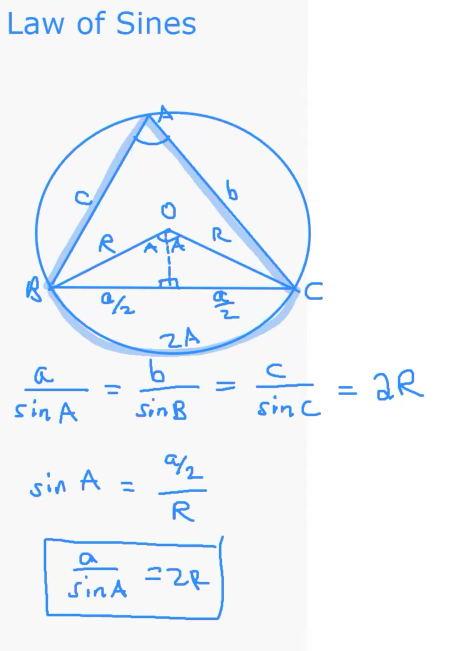
- Law of Sines: In triangle $ABC$, $BC = a$, $AC = b$, $AB = c$, we can get
$$\frac{a}{\sin A} = \frac{b}{\sin B} = \frac{c}{\sin C} = 2R$$
($R$ is the radius of the circumcircle of triangle $ABC$).
#Law_Of_Cosines
- Law of Cosines: In the triangle $ABC$, $BC = a$, $AC = b$, $AB = c$, we can get
$$c^2 = a^2 + b^2 - 2ab \cos C$$
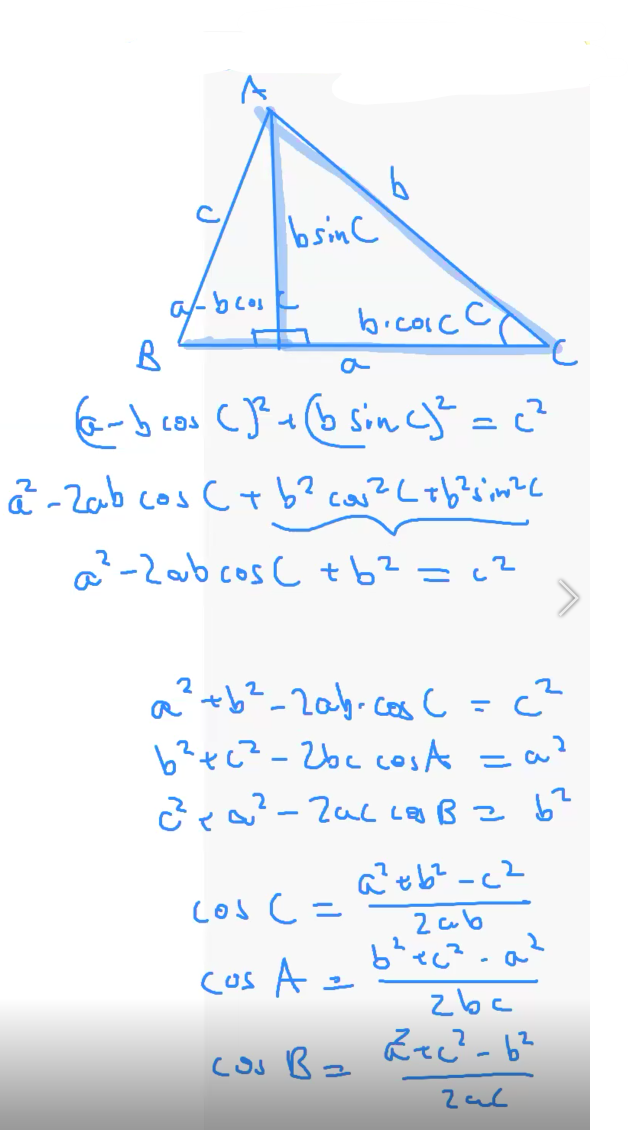
- The area of triangle $ABC$:
$$\text{Area} = \frac{1}{2} ab \sin C$$
17 ) If the area of $\triangle ABC$ is $64$ square inches and the geometric mean (mean proportional) between sides $AB$ and $AC$ is $12$ inches, then $\sin A$ is equal to
(A) $\dfrac{\sqrt{3}}{2}$
(B) $\dfrac{3}{5}$
(C) $\dfrac{4}{5}$
(D) $\dfrac{8}{9}$
(E) $\dfrac{15}{17}$
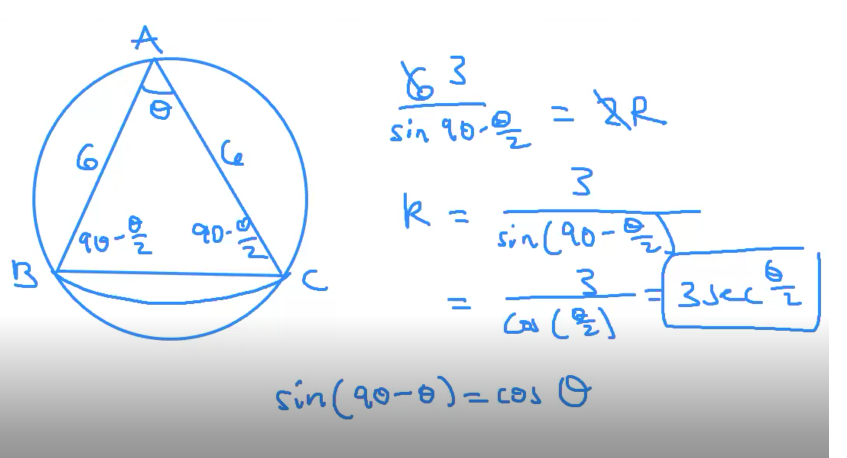
A sector with acute central angle $\theta$ is cut from a circle of radius $6$. The radius of the circle circumscribed about the sector is
(A) $3 \cos \theta$
(B) $3 \sec \theta$
(C) $3 \cos \frac{1}{2} \theta$
(D) $3 \sec \frac{1}{2} \theta$
(E) $3$
21 ) $ABCD$ is a square and and are the midpoints of and respectively. Then
(A) $\dfrac{\sqrt{5}}{5}$
(B) $\dfrac{3}{5}$
(C) $\dfrac{\sqrt{10}}{5}$
(D) $\dfrac{4}{5}$
(E) none of these
(1987 AHSME Problems/Problem 14)
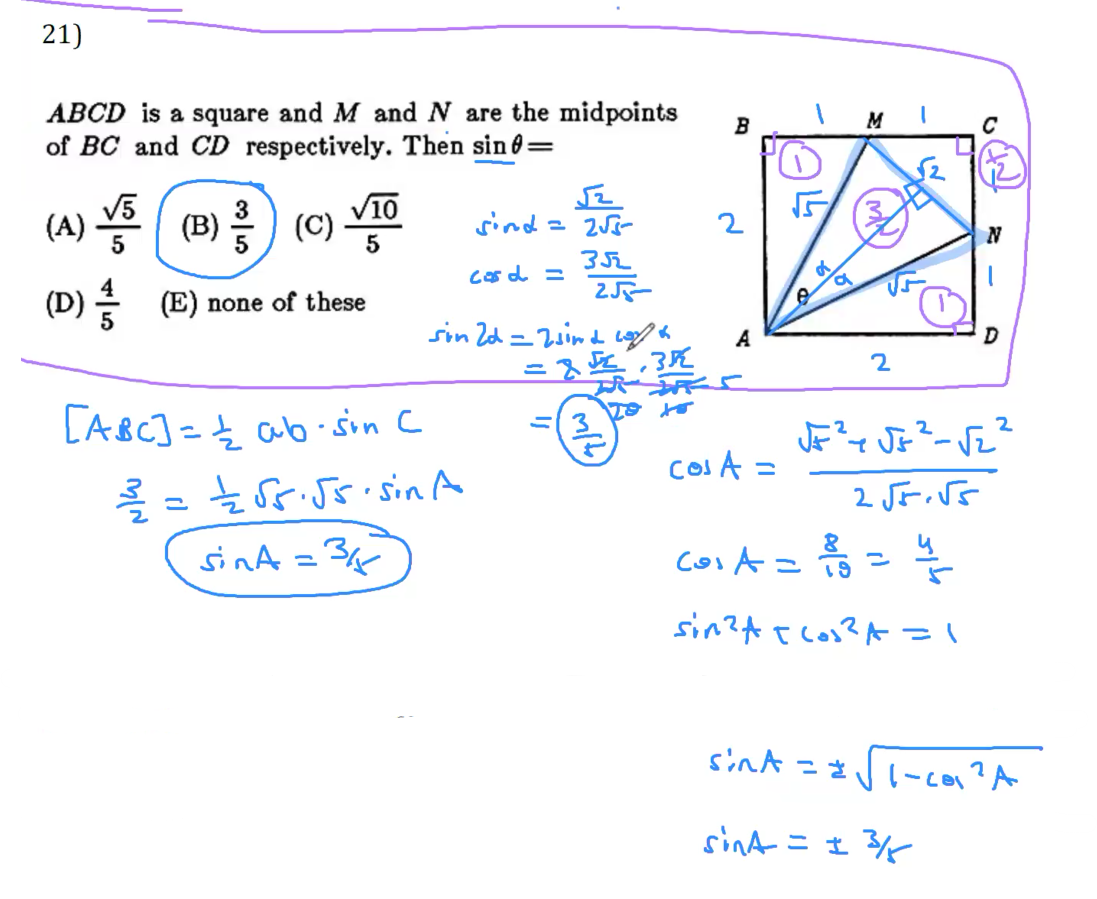
Method 1: Area Formula
- Define the square $ABCD$ with side length $2$.
- By Pythagorean theorem, $AM = \sqrt{2^2 + 1^2} = \sqrt{5}$ and $AN = \sqrt{2^2 + 1^2} = \sqrt{5}$.
- The area of $\triangle AMN$ is calculated by subtracting three right triangles from the square: $4 - (1 + 1 + 0.5) = 1.5$.
- Using the area formula $\text{Area} = \frac{1}{2}ab \sin \theta$:
$$1.5 = \frac{1}{2}(\sqrt{5})(\sqrt{5}) \sin \theta$$
$$1.5 = 2.5 \sin \theta \implies \sin \theta = \frac{3}{5}$$
Method 2: Law of Cosines
- Identify the sides of $\triangle AMN$ as $AM = \sqrt{5}$, $AN = \sqrt{5}$, and $MN = \sqrt{1^2 + 1^2} = \sqrt{2}$.
- Apply the Law of Cosines to find $\cos \theta$:
$$\cos \theta = \frac{(\sqrt{5})^2 + (\sqrt{5})^2 - (\sqrt{2})^2}{2(\sqrt{5})(\sqrt{5})} = \frac{5 + 5 - 2}{10} = \frac{8}{10} = \frac{4}{5}$$
- Use the identity $\sin^2 \theta + \cos^2 \theta = 1$:
$$\sin \theta = \sqrt{1 - (4/5)^2} = \sqrt{9/25} = \frac{3}{5}$$
Method 3: Double Angle Identity
- Let $\alpha$ be the angle such that $\theta = 90^\circ - 2\alpha$, where $\alpha = \angle BAM = \angle DAN$.
- From $\triangle BAM$, $\sin \alpha = \frac{1}{\sqrt{5}}$ and $\cos \alpha = \frac{2}{\sqrt{5}}$.
- Calculate $\sin \theta$ using $\cos(2\alpha)$ or the specific geometric decomposition shown:
$$\sin(2\alpha) = 2 \sin \alpha \cos \alpha = 2 \left(\frac{1}{\sqrt{5}}\right) \left(\frac{2}{\sqrt{5}}\right) = \frac{4}{5}$$
- The specific annotation follows the derivation leading to:
$$\sin \theta = \frac{3}{5}$$
20 ) The lengths of the sides of a triangle are consecutive integers, and the largest angle is twice the smallest angle. The cosine of the smallest angle is
(A) $\dfrac{3}{4}$ (B) $\dfrac{7}{10}$ (C) $\dfrac{2}{3}$ (D) $\dfrac{9}{14}$ (E) none of these
To find the cosine of the smallest angle in a triangle with consecutive integer sides $(n-1, n, n+1)$ where the largest angle $\alpha$ is twice the smallest angle $\beta$ ($\alpha = 2\beta$):
1. Identify Sides: The smallest side is $a = n-1$ (opposite $\beta$) and the largest side is $c = n+1$ (opposite $\alpha$).
2. Apply Law of Sines:
$$\frac{a}{\sin \beta} = \frac{c}{\sin 2\beta} \implies \frac{n-1}{\sin \beta} = \frac{n+1}{2 \sin \beta \cos \beta}$$
3. Solve for $\cos \beta$:
$$\cos \beta = \frac{n+1}{2(n-1)}$$
4. Apply Law of Cosines:
$$(n+1)^2 = (n-1)^2 + n^2 - 2n(n-1) \cos \beta$$
Substitute $\cos \beta$:
$$(n+1)^2 = (n-1)^2 + n^2 - 2n(n-1) \left[ \frac{n+1}{2(n-1)} \right]$$ $$(n+1)^2 = (n-1)^2 + n^2 - n(n+1)$$
5. Find $n$:$$n^2 + 2n + 1 = n^2 - 2n + 1 + n^2 - n^2 - n$$
6.
$$2n = -3n + n^2 \implies 5n = n^2 \implies n = 5$$
7. Calculate Final Value:
$$\cos \beta = \frac{5+1}{2(5-1)} = \frac{6}{8} = \frac{3}{4}$$
Answer: (A) $\dfrac{3}{4}$
23 ) Two rays with common endpoint $O$ form a $30^\circ$ angle. Point $A$ lies on one ray, point $B$ on the other ray, and $AB = 1$. The maximum possible length of $OB$ is
(A) $1$ (B) $\dfrac{1 + \sqrt{3}}{\sqrt{2}}$ (C) $\sqrt{3}$ (D) $2$ (E) $\dfrac{4}{\sqrt{3}}$
#Median_Formula #Apollonius_Theorem
The length of the median $m_c$ to side $c$ is given by:
$$m_c = \frac{1}{2}\sqrt{2a^2 + 2b^2 - c^2}$$
Proof
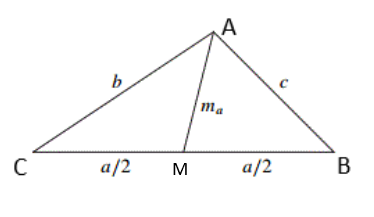
Consider $\triangle ABC$ with median $AM$ to side $BC$ (where $BC=a$). Let $AM = m_a$.
1. Apply Law of Cosines to $\triangle ABM$ and $\triangle ACM$:
- $c^2 = m_a^2 + (\dfrac{a}{2})^2 - 2m_a(\dfrac{a}{2})\cos(\angle AMB)$
- $b^2 = m_a^2 + (\dfrac{a}{2})^2 - 2m_a(\dfrac{a}{2})\cos(180^\circ - \angle AMB)$
2. Simplify: Since $\cos(180^\circ - \theta) = -\cos\theta$, the second equation becomes:
- $b^2 = m_a^2 + \frac{a^2}{4} + am_a\cos(\angle AMB)$
3. Sum the equations:
- $b^2 + c^2 = 2m_a^2 + \frac{a^2}{2}$
4. Solve for $m_a$:
- $2m_a^2 = b^2 + c^2 - \dfrac{a^2}{2} = \dfrac{2b^2 + 2c^2 - a^2}{2}$
- $m_a^2 = \dfrac{2b^2 + 2c^2 - a^2}{4} \implies m_a = \dfrac{1}{2}\sqrt{2b^2 + 2c^2 - a^2}$
Or
Proof by Extending the Triangle
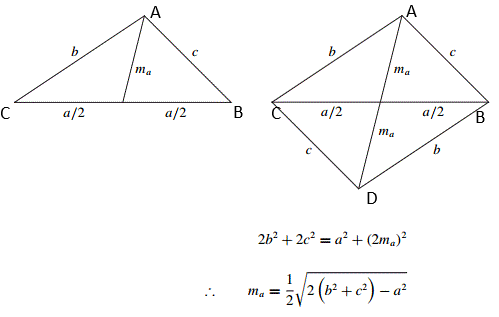
- Construct a Parallelogram: Start with $\triangle ABC$ where $m_a$ is the median to side $a$ (base $BC$). Extend the median $m_a$ from the midpoint $M$ to a point $D$ such that $AM = MD = m_a$.
- Identify the Diagonals: By connecting the vertices, you form a parallelogram $ABDC$. In this parallelogram:
- The diagonals are $AD = 2m_a$ and $BC = a$.
- The sides are $AB = c$ and $AC = b$.
- Parallelogram Law: A fundamental property of parallelograms states that the sum of the squares of the lengths of the four sides is equal to the sum of the squares of the lengths of the two diagonals:
$$AB^2 + BD^2 + DC^2 + CA^2 = AD^2 + BC^2$$
- Substitute the Lengths: Since opposite sides of a parallelogram are equal, $BD = AC = b$ and $DC = AB = c$.
$$c^2 + b^2 + c^2 + b^2 = (2m_a)^2 + a^2$$
- Final Formula: Simplifying this results in:
$$2b^2 + 2c^2 = (2m_a)^2 + a^2$$
By further isolating $m_a$, you reach the standard median length formula:
$$m_a = \frac{1}{2}\sqrt{2b^2 + 2c^2 - a^2}$$
25 ) In $\triangle ABC$, we have $AB = 1$ and $AC = 2$. Side $\overline{BC}$ and the median from $A$ to $\overline{BC}$ have the same length. What is $BC$?
( 2002 AMC 12B Problems/Problem 23)
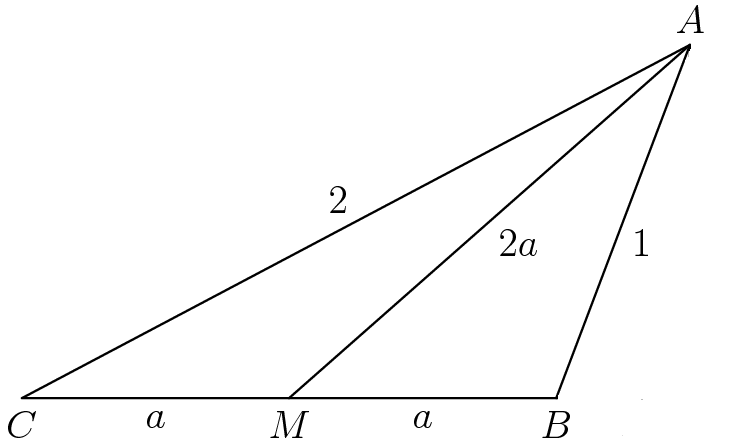
(A) $\dfrac{1 + \sqrt{2}}{2}$ (B) $\dfrac{1 + \sqrt{3}}{2}$ (C) $\sqrt{2}$ (D) $\dfrac{3}{2}$ (E) $\sqrt{3}$
4 ) Equilateral triangle $ABC$ has been creased and folded so that vertex $A$ now rests at $A'$ on $BC$. If $BA' = 1$ and $A'C = 2$, then what is the length of crease $PQ$?
(1991 AHSME Problems/Problem 29)
5 ) In quadrilateral $ABCD$, we have $\angle A = \angle C$, $AB = CD = 180$, and $AD \neq BC$. The perimeter of $ABCD$ is $640$. Find $\cos A$.
Solution for Quadrilateral $ABCD$
1. Set Up Variables:
- $AB = CD = 180$
- Let $AD = x$ and $BC = y$
- $\angle A = \angle C$
2. Use Perimeter:
- $180 + 180 + x + y = 640$
- $x + y = 280 \implies y = 280 - x$
3. Apply Law of Cosines:
- Draw diagonal $BD$ to create $\triangle ABD$ and $\triangle BCD$.
- $BD^2 = 180^2 + x^2 - 2(180)(x) \cos A$
- $BD^2 = 180^2 + y^2 - 2(180)(y) \cos C$
- Since $\angle A = \angle C$ and $BD$ is common, set equations equal:
$180^2 + x^2 - 360x \cos A = 180^2 + y^2 - 360y \cos A$
4. Solve for $\cos A$:
- $x^2 - y^2 = 360x \cos A - 360y \cos A$
- $(x - y)(x + y) = 360 \cos A (x - y)$
- Since $AD \neq BC$ ($x \neq y$), divide by $(x - y)$:
$x + y = 360 \cos A$
- Substitute $x + y = 280$:
$280 = 360 \cos A$
- $\cos A = \dfrac{280}{360} = \dfrac{7}{9}$
Answer: $\cos A = \dfrac{7}{9}$
6 ) Quadrilateral $ABCD$ is inscribed in a circle with sides $AB = 2$, $BC = 3$, $CD = 4$, and $DA = 6$. Find $AC$.
Solution
Since $ABCD$ is a cyclic quadrilateral, opposite angles sum to $180^\circ$. Let $\angle ABC = \theta$ and $\angle ADC = 180^\circ - \theta$.
Applying the Law of Cosines to $\triangle ABC$ and $\triangle ADC$:
1. In $\triangle ABC$:
$AC^2 = 2^2 + 3^2 - 2(2)(3)\cos \theta = 13 - 12\cos \theta$
2. In $\triangle ADC$:
$AC^2 = 6^2 + 4^2 - 2(6)(4)\cos(180^\circ - \theta) = 52 + 48\cos \theta$
(Note: $\cos(180^\circ - \theta) = -\cos \theta$)
Equating the two expressions for $AC^2$:
$13 - 12\cos \theta = 52 + 48\cos \theta$
$-39 = 60\cos \theta$
$\cos \theta = -\dfrac{39}{60} = -\dfrac{13}{20}$
Substitute $\cos \theta$ back into the first equation:
$AC^2 = 13 - 12\left(-\dfrac{13}{20}\right)$
$AC^2 = 13 + \dfrac{3 \cdot 13}{5} = 13 + \dfrac{39}{5}$
$AC^2 = \dfrac{65 + 39}{5} = \dfrac{104}{5}$
Final Answer:
$$AC = \sqrt{\frac{104}{5}} = \frac{2\sqrt{130}}{5}$$
8 ) Triangle $ABC$ has a right angle at $B$ and contains a point $P$ for which $PA=10$, $PB=6$ and $\angle APB = \angle BPC = \angle CPA = 120^\circ$. Find $PC$.
Solution
1. Analyze the Angles: Since the angles around point $P$ sum to $360^\circ$ and are equal, $\angle APB = \angle BPC = \angle CPA = 120^\circ$.
2. Law of Cosines in $\triangle APB$:
$$AB^2 = PA^2 + PB^2 - 2(PA)(PB)\cos(120^\circ)$$
$$AB^2 = 10^2 + 6^2 - 2(10)(6)(-0.5) = 100 + 36 + 60 = 196 \implies AB = 14$$
3. Law of Cosines in $\triangle BPC$: Let $PC = x$.
$$BC^2 = PB^2 + PC^2 - 2(PB)(PC)\cos(120^\circ)$$
$$BC^2 = 6^2 + x^2 - 2(6)(x)(-0.5) = 36 + x^2 + 6x$$
4. Law of Cosines in $\triangle CPA$:
$$AC^2 = PA^2 + PC^2 - 2(PA)(PC)\cos(120^\circ)$$
$$AC^2 = 10^2 + x^2 - 2(10)(x)(-0.5) = 100 + x^2 + 10x$$
5. Pythagorean Theorem: Since $\angle ABC = 90^\circ$, $AB^2 + BC^2 = AC^2$.
$$196 + (36 + x^2 + 6x) = 100 + x^2 + 10x$$
$$232 + x^2 + 6x = 100 + x^2 + 10x$$
6. Solve for $x$:
$$232 - 100 = 10x - 6x$$
$$132 = 4x \implies x = 33$$
Answer: $PC = 33$
16 ) In $\triangle ABC$, point $D$ lies on side $BC$. Given $\angle CAD = \angle DAB = 60^\circ$, $AC = 3$, and $AB = 6$, find the length of $AD$.
Solution
Let $AD = x$. The area of $\triangle ABC$ is the sum of the areas of $\triangle ACD$ and $\triangle ABD$.
Using the area formula $\text{Area} = \frac{1}{2}ab \sin C$:
- $\text{Area}(\triangle ABC) = \frac{1}{2}(3)(6) \sin(120^\circ) = 9 \cdot \frac{\sqrt{3}}{2} = \frac{9\sqrt{3}}{2}$
- $\text{Area}(\triangle ACD) = \frac{1}{2}(3)(x) \sin(60^\circ) = \frac{3x\sqrt{3}}{4}$
- $\text{Area}(\triangle ABD) = \frac{1}{2}(6)(x) \sin(60^\circ) = \frac{6x\sqrt{3}}{4}$
Setting the sum equal to the total area:
$$\frac{3x\sqrt{3}}{4} + \frac{6x\sqrt{3}}{4} = \frac{9\sqrt{3}}{2}$$
$$\frac{9x\sqrt{3}}{4} = \frac{9\sqrt{3}}{2}$$
$$\frac{x}{4} = \frac{1}{2} \implies x = 2$$
Answer: $AD = 2$
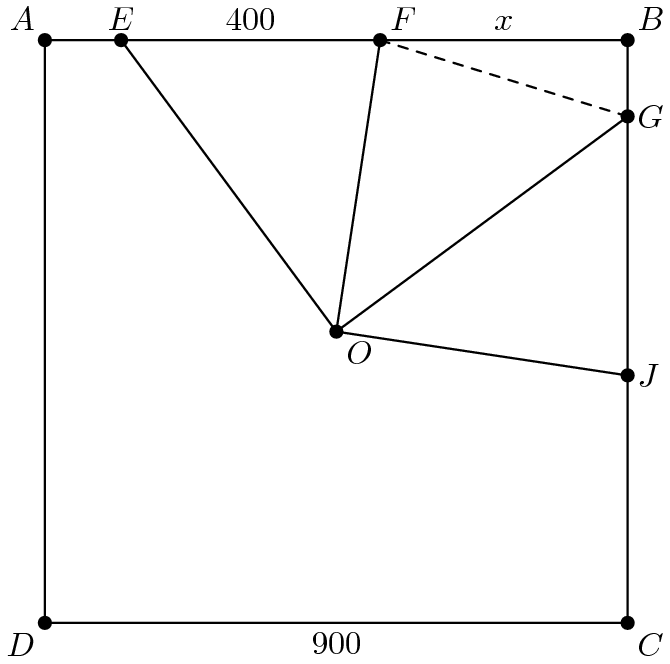
3 ) Square $ABCD$ has center $O$ and $AB=900$. Points $E$ and $F$ are on $AB$ with $AE < BF$ and $E$ between $A$ and $F$ such that $\angle EOF = 45^\circ$ and $EF=400$. Find $BF$.
(2005 AIME II Problems/Problem 12)